VPS (Virtual Private Server)
VPS (Virtual Private Server) is a virtualized computing environment provisioned within a shared physical host server, where the hypervisor allocates dedicated slices of CPU, RAM, and storage to each tenant; VPS providers (Hetzner, DigitalOcean, Vultr, Linode/Akamai, etc.) run hypervisors (KVM being the most common) on large physical servers and create isolated virtual machine instances with guaranteed resource allocations; A $5 to $10/month VPS is the default first step for builders moving beyond shared hosting
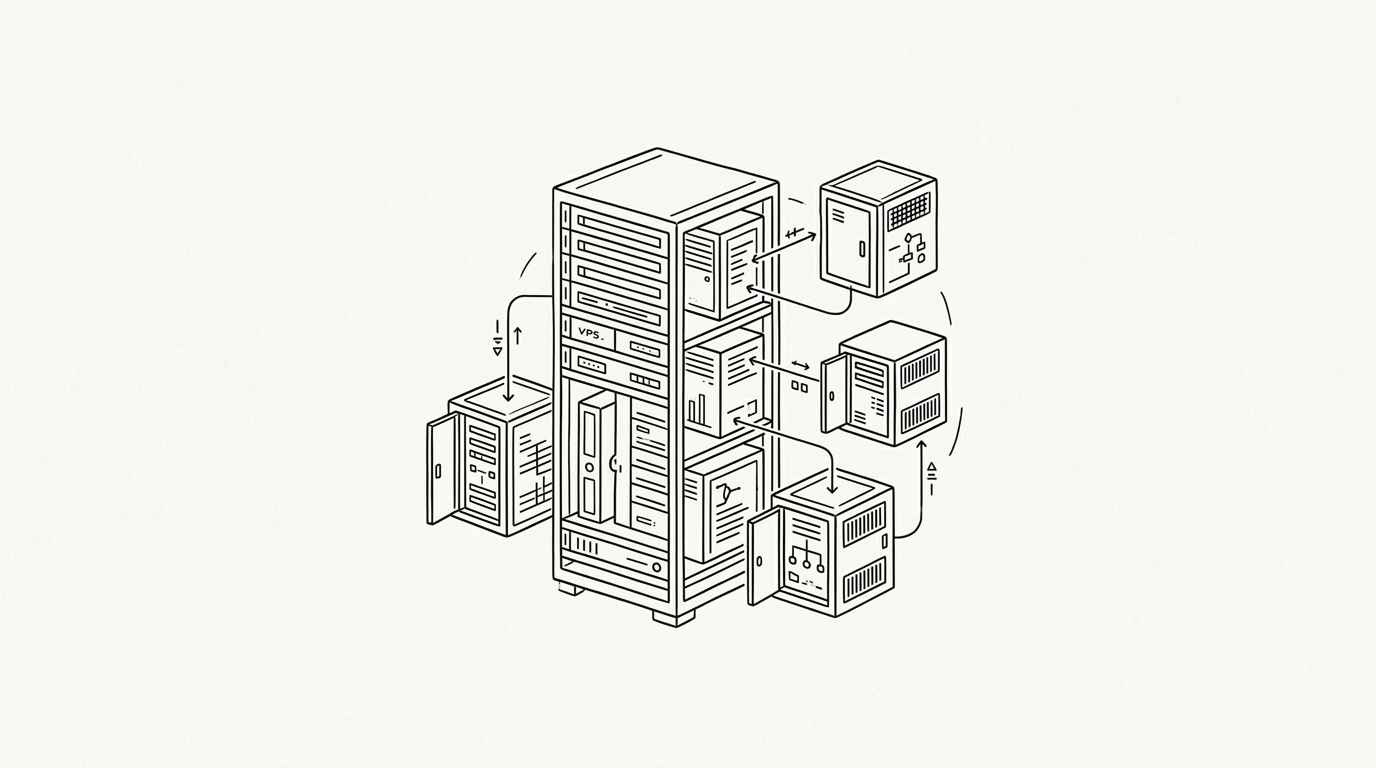

VPS (Virtual Private Server) is a virtualized computing environment provisioned within a shared physical host server, where the hypervisor allocates dedicated slices of CPU, RAM, and storage to each tenant. Unlike shared web hosting, a VPS gives the user root access to a full operating system instance, allowing installation of any software and full control over the networking and service configuration. VPS instances are the most common infrastructure choice for builders self-hosting applications that need to be publicly accessible.
How it works
VPS providers (Hetzner, DigitalOcean, Vultr, Linode/Akamai, etc.) run hypervisors (KVM being the most common) on large physical servers and create isolated virtual machine instances with guaranteed resource allocations. Each VPS instance runs its own kernel and OS, is network-isolated from other tenants, and appears to software as a standalone dedicated server. Storage is provided as network-attached block devices (SSDs) rather than local disks, which affects I/O performance characteristics.
Key facts
- Entry pricing: Hetzner’s CX22 (2 vCPU, 4 GB RAM) runs approximately $4 to $5/month, making it the price-performance benchmark for European VPS
- vs. bare metal: VPS adds hypervisor overhead (typically 5 to 15 percent CPU penalty) but offers instant provisioning, snapshots, and easy resize operations
- Network egress pricing: DigitalOcean and AWS charge for outbound bandwidth above a threshold; Hetzner and Vultr include 20 TB or more per month at no extra cost
For builders
A $5 to $10/month VPS is the default first step for builders moving beyond shared hosting. A single small VPS running Docker with Nginx as a reverse proxy can host a surprisingly large number of lightweight services: a personal Git server, a password manager backend, a status page, a webhook receiver, and a VPN endpoint simultaneously. The operational overhead of managing a VPS is modest if Docker Compose is used for service management.
Sources
- CNCF. Annual Survey on cloud-native adoption. cncf.io
- Proxmox Server Solutions. Proxmox VE documentation. proxmox.com
- Intel. Embedded and small-form-factor server platforms documentation. intel.com
- AMD. Embedded and edge-server processor documentation. amd.com
- ServeTheHome. Enterprise and homelab hardware testing. servethehome.com
