Homelab
Homelab is the informal term for a personal or small-team server environment operated from a residential or office location, primarily for the purpose of learning systems administration, experimenting with software infrastructure, and running self-hosted services; A typical homelab setup involves dedicated hardware connected to a home network, running either bare metal services or a hypervisor (Proxmox, VMware ESXi, or Hyper-V) that virtualizes multiple workloads; For builders who travel and self-host, the homelab introduces a dependency on the home internet connection's uptime and the hardware's reliability
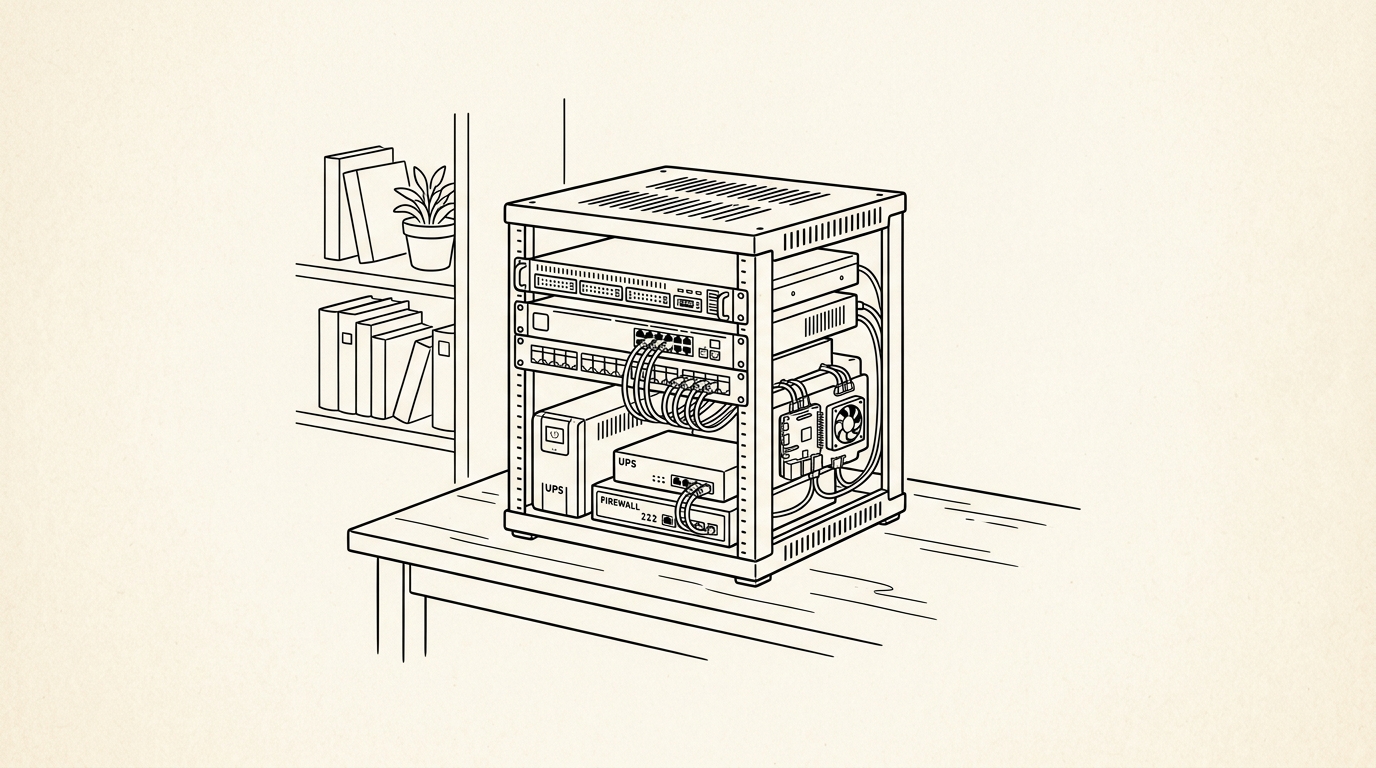

Homelab is the informal term for a personal or small-team server environment operated from a residential or office location, primarily for the purpose of learning systems administration, experimenting with software infrastructure, and running self-hosted services. Homelabs range from a single Raspberry Pi running a Pi-hole ad blocker to racks of enterprise servers running virtualization platforms like Proxmox with dozens of VMs and containers. The defining spirit is ownership, experimentation, and learning by doing rather than production reliability.
How it works
A typical homelab setup involves dedicated hardware connected to a home network, running either bare metal services or a hypervisor (Proxmox, VMware ESXi, or Hyper-V) that virtualizes multiple workloads. Internet-facing services are exposed via a reverse proxy (Nginx, Traefik, Caddy) or a secure tunnel (Cloudflare Tunnel, Tailscale), avoiding the need to open inbound firewall ports. NAS storage (TrueNAS or a dedicated device) handles bulk storage needs. Power and cooling management become practical concerns as the lab grows.
Key facts
- Entry hardware: Repurposed mini PCs (Intel NUC, Beelink, Minisforum) offer low idle power draw and are popular homelab starting points
- Community hubs: r/homelab and r/selfhosted on Reddit and the ServeTheHome forums are the primary community resources
- Power cost: A single always-on server drawing 50W adds roughly $50 to $100 per year in electricity depending on local rates; full rack builds draw much more
For builders
For builders who travel and self-host, the homelab introduces a dependency on the home internet connection’s uptime and the hardware’s reliability. Running critical self-hosted services (VPN, password manager, Git server) on a VPS rather than a home server eliminates the single point of failure of a home power or ISP outage. Many builders maintain a homelab for experimentation and NAS storage while running production-critical services on a VPS.
Sources
- Docker, Inc. Get started with Docker, overview and architecture. docs.docker.com
- Kubernetes. Cluster overview and concepts documentation. kubernetes.io
- CNCF. Cloud Native Computing Foundation Annual Survey. cncf.io
- NIST SP 800-190. Application Container Security Guide. nist.gov
- r/selfhosted wiki. Community knowledge base. reddit.com
