Gross Margin
Gross margin is calculated as (Revenue minus Cost of Goods Sold) / Revenue, expressed as a percentage; Cost of Goods Sold (COGS) for a SaaS business typically includes hosting and infrastructure costs, third-party software embedded in the product, customer support labor, and payment processing fees; Founders often undercount their true COGS by forgetting to include the cost of their customer success team, payment processing fees (Stripe charges 2.9% + $0.30), or third-party APIs embedded in the product
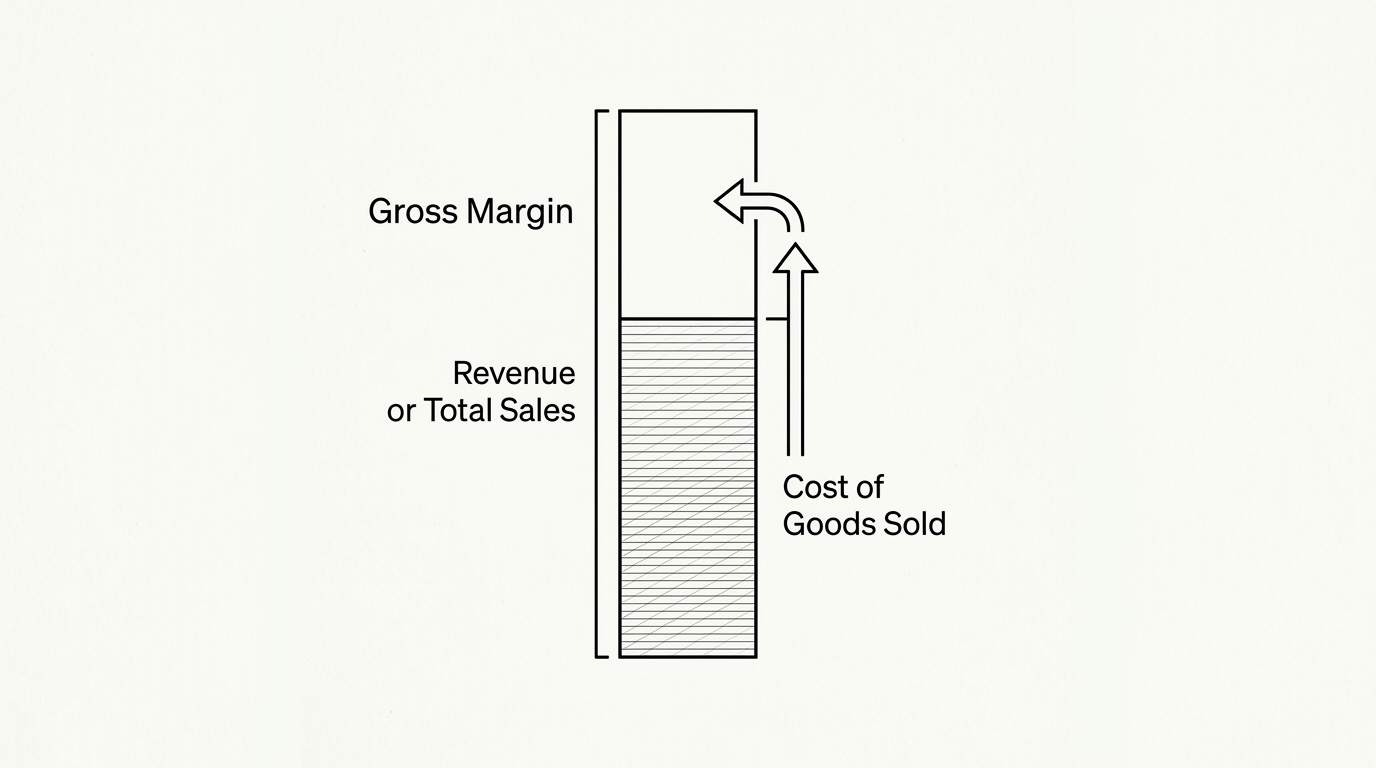

Gross margin is calculated as (Revenue minus Cost of Goods Sold) / Revenue, expressed as a percentage. It measures the profitability of the core product or service before accounting for operating expenses like sales, marketing, and general and administrative costs. High gross margins indicate that the business retains most of each revenue dollar to cover overhead and generate profit; low gross margins leave little room to absorb operating expenses without running at a loss.
How it works
Cost of Goods Sold (COGS) for a SaaS business typically includes hosting and infrastructure costs, third-party software embedded in the product, customer support labor, and payment processing fees. It excludes sales and marketing, R and D, and G and A expenses. Gross profit equals Revenue minus COGS; gross margin is gross profit divided by revenue. For example, a SaaS company with $1M in revenue and $150K in COGS has a gross profit of $850K and a gross margin of 85%.
Key facts
- SaaS benchmarks: Software-only SaaS businesses typically achieve 70-85% gross margins; businesses with significant services or support components often fall in the 50-65% range.
- Publisher economics: Content/advertising businesses have highly variable gross margins depending on whether they treat content creation as COGS or as operating expense.
- Investor focus: Gross margin is one of the first metrics investors examine in SaaS businesses because it bounds the maximum operating leverage the business can achieve.
For builders
Founders often undercount their true COGS by forgetting to include the cost of their customer success team, payment processing fees (Stripe charges 2.9% + $0.30), or third-party APIs embedded in the product. Accurately calculating gross margin reveals whether the unit economics of the business are fundamentally sound before adding the sales and marketing engine. A SaaS business that only has 50% gross margins will struggle to ever be profitable at scale, since there is not enough gross profit to cover typical operating expense ratios.
Sources
- FASB. Financial Accounting Standards Board standards (US GAAP). fasb.org
- IFRS Foundation. International Financial Reporting Standards. ifrs.org
- IRS. Small business tax and accounting guidance. irs.gov
- AICPA-CIMA. Accounting standards and resources. aicpa-cima.com
- U.S. SEC. EDGAR public filings database. sec.gov
