Cap Table
Cap table (capitalization table) is a complete record of a company's equity ownership structure, listing every shareholder, the type and quantity of their equity (common stock, preferred stock, options, warrants, SAFEs, convertible notes), and their ownership percentage on a fully diluted basis; At formation, founders hold all shares as common stock; Founders who raise any outside capital, even from friends and family via SAFEs, need a properly maintained cap table from day one
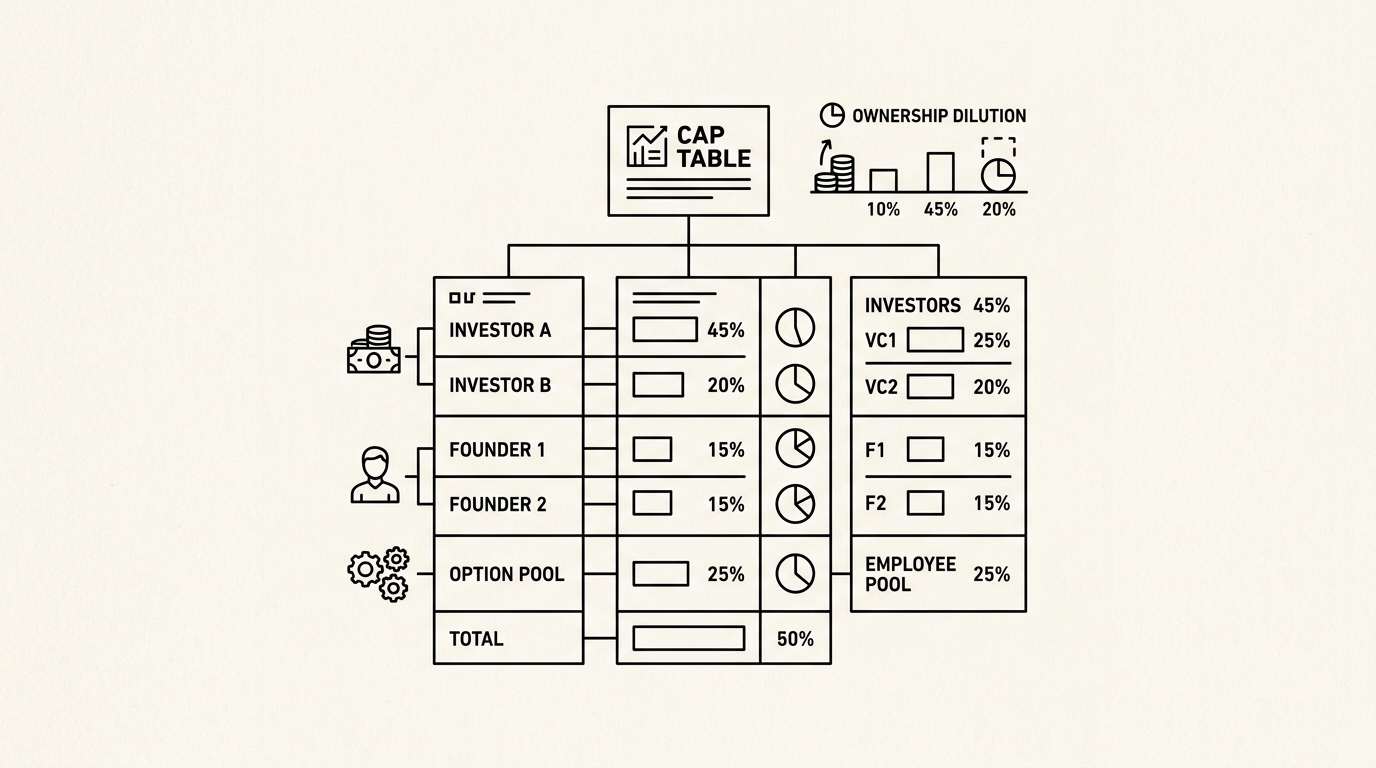

Cap table (capitalization table) is a complete record of a company’s equity ownership structure, listing every shareholder, the type and quantity of their equity (common stock, preferred stock, options, warrants, SAFEs, convertible notes), and their ownership percentage on a fully diluted basis. It is a living document that changes with every new financing round, option grant, secondary sale, or instrument conversion. The cap table is central to understanding economic and voting rights, modeling dilution, and running scenarios for future financings or exits.
How it works
At formation, founders hold all shares as common stock. As the company raises money, investors receive preferred stock or convertible instruments that are tracked on the cap table alongside the existing equity. Option pools are carved out of the founder shares to compensate employees; as options vest and are exercised, they convert to common stock. Software platforms like Carta, Pulley, and Capshare automate cap table management, 409A valuations, and scenario modeling to replace error-prone spreadsheets.
Key facts
- Fully diluted vs. outstanding: Fully diluted share count includes all options, warrants, and convertible instruments as if already converted; outstanding shares only count currently issued shares.
- Option pool shuffle: VCs often require expanding the option pool before a financing, which dilutes existing shareholders (especially founders) rather than the new investors.
- Pro-rata rights: Investors often negotiate the right to participate in future rounds to maintain their ownership percentage, which is tracked on the cap table.
For builders
Founders who raise any outside capital, even from friends and family via SAFEs, need a properly maintained cap table from day one. Errors in cap tables can delay or kill acquisitions and later funding rounds, since buyers and investors conduct detailed equity audits in due diligence. Using dedicated cap table software from the first external investment is far cheaper than fixing retroactive errors with lawyers before a Series A or exit.
Sources
- Y Combinator. SAFE (Simple Agreement for Future Equity) standard documents. ycombinator.com
- U.S. SEC. Exempt offerings and small-business capital raising. sec.gov
- National Venture Capital Association. Model legal documents. nvca.org
- Kauffman Foundation. Startup research and entrepreneurship data. kauffman.org
- Federal Reserve. Small Business Credit Survey. federalreserve.gov
